

Cryptographically Verifiable Security.
Enterprise vendor risk management requires more than attestations; it requires verifiable proof. Qgentic is architected to exceed the scrutiny of regulated institutions (including DORA's own ICT third-party requirements). Every security control detailed below is technically reproducible within your own environment, against your own data, during technical validation.
Strict Isolation of Non-Deterministic Execution.
Our platform enforces a strict architectural boundary. AI/LLM models are relegated exclusively to data extraction and synthesis. All validation, classification, and final schema compilation are executed by static, deterministic logic gates. Non-deterministic output cannot corrupt a regulatory record because it must successfully traverse the deterministic validation layer prior to commit.
| Deterministic Layer (Validation & Logic) | Non-Deterministic Layer (Extraction & Synthesis) |
|---|---|
| Cryptographic checksums: ISO 17442 LEI (MOD 97-10), VRN mod-97, FRN regex | Unstructured data extraction (contracts, policies) to JSON schema |
| ISO 3166 / 4217 validation · Regime-specific static rules engines | Automated generation of vendor outreach communications |
| Mathematical derivation: VAT aggregation, SLA/tolerance-breach calculations | Agentic exploration and data correlation |
| SHA-256 audit chaining · IAM/JIT token issuance · Payload hashing | — (Note: MTD module operates strictly deterministically without AI) |
Model degradation impacts processing latency (via retry loops) but cannot alter the cryptographic integrity or validity of the finalised regulatory payload.
Tamper-Evident SHA-256 Audit Chains.
Continuous Cryptographic Verification
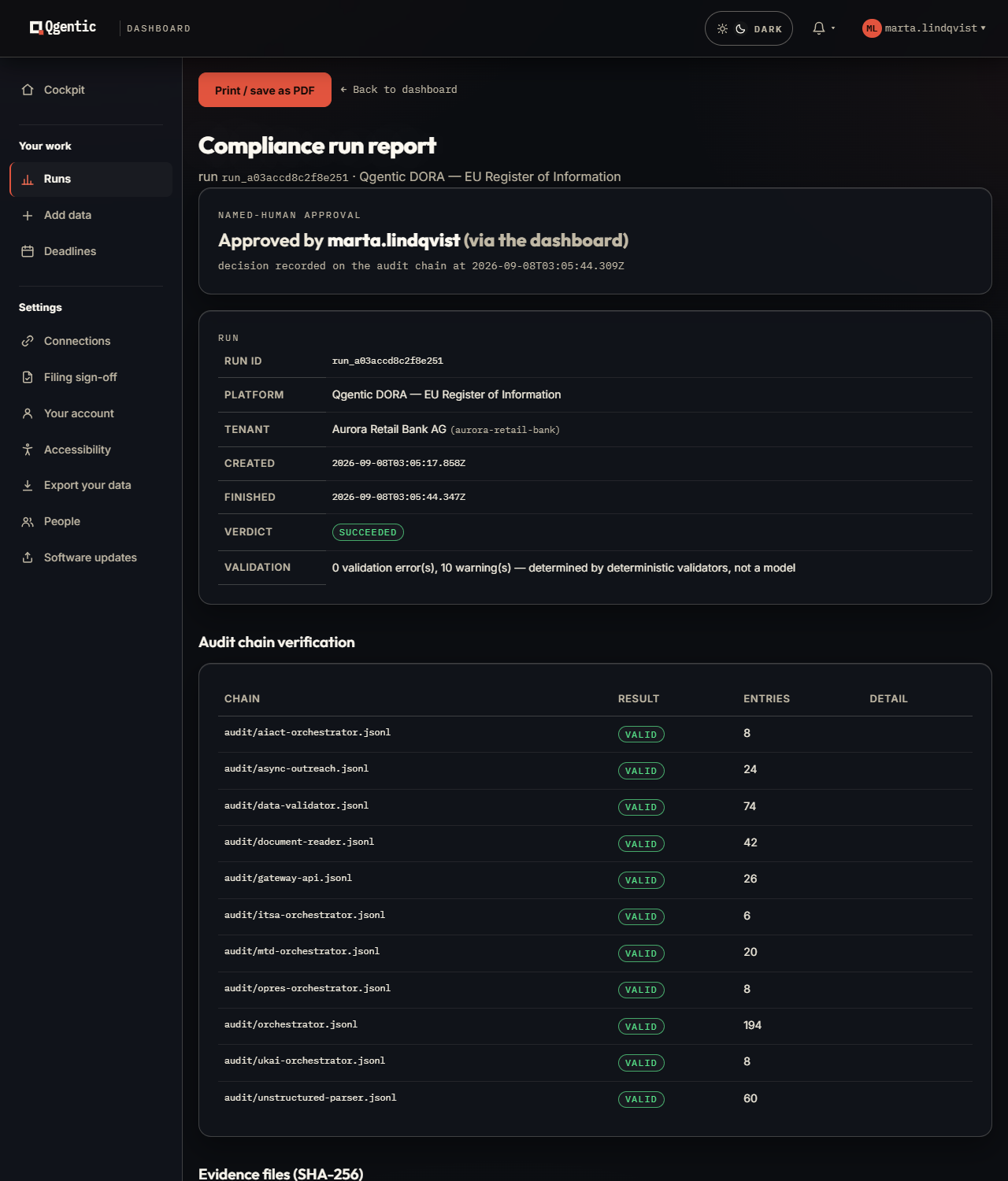
Microservices append state changes to isolated SHA-256 hash chains. Each node hashes the preceding hash concatenated with the canonical payload. Chains undergo continuous integrity verification and support offline verification via independent tooling.
Execution verifies five distinct service chains. In SaaS deployments, a sixth chain audits API gateway activity and IAM approvals. Execution evidence is packaged as a hashed archive with a human-readable attribution report. Complete dataset export capability keeps the platform portable.
Zero Standing Privileges (ZSP) via JIT Tokens
High-privilege actions (e.g., regulatory submission, bulk export) require ephemeral, HMAC-signed capabilities with tight TTL boundaries. Tokens are minted strictly following IAM-authenticated human approval. The approval, minting, and execution are recorded as discrete, auditable events.
Flexible Infrastructure and Data Boundaries.
Multi-Tenant Cloud
Logical multi-tenant isolation. API credentials hashed (SHA-256) at rest, shown once at generation. Regional data residency (UK/EU), enforced. Every sub-processor documented, with contractual notice before any change.
Single-Tenant Cloud
Physical isolation within a dedicated VPC. Integration with enterprise KMS for customer-managed encryption keys (CMEK). Change management controls including named maintenance windows.
Zero-Trust / Air-Gapped
Statically compiled binary deployment. Zero external telemetry, zero sub-processors, and disabled API access (enforcing local deterministic processing). In-process egress controls actively block and log outbound requests. Fully verifiable via standard enterprise network monitoring.
The delivery mechanics behind the on-premise topologies — cosign-signed images, pinned digests, IT-run updates and the pre-answered change request — are documented on the deployment & updates page.
Zero-Impact ERP Integration Architecture.
Asynchronous File Ingestion
Support for watched-directory integrations within the enterprise perimeter. Compatible with legacy ERP exports (e.g., SAP AL11 output). Unidirectional data flow; Qgentic never requires write access to the source ERP.
REST API Polling
Read-only integration against REST endpoints you expose, authenticated with scoped bearer tokens. Pull model only: nothing external ever writes into your ERP.
Enterprise Middleware Compatibility
Works with the iPaaS you already run — SAP CPI, MuleSoft, Boomi. Standardised boundary contracts make integration configuration, not an engineering project.
Bring Your Due Diligence.
Pre-Contractual Artefacts
A full security dossier, a lockfile-generated SBOM, signed binaries with published SHA-256 hashes, source-code review under NDA, and local technical validation. Everything your security team will ask for, ready before they ask.
Contractual Security Commitments
Pre-populated DORA register documentation (B_05.01, B_02.02, B_07.01). Schedules incorporating Article 30 audit/access rights, defined exit/export protocols, sub-processor limitations, and explicit, documented capability boundaries.
Verifiability. Trust claims are worth nothing without a way to check them. Qgentic gives you the way: deterministic execution, full auditability, and air-gapped deployment if you want it. Send your security team. We built this for them.